August 16 is National Rum Day in the United States. I'm not sure how or when it originated. Most likely this is some commercial ploy to sell booze. Regardless, I am already a fan of rum and happily support this silly celebration. To commemorate the occasion, I am proudly sporting a Flor de Caña t-shirt in honor of my favorite rum. It is a critically acclaimed rum, one of if not THE best in the world, made in the lovely land of Nicaragua. My mother's country knows how to make an excellent rum and I proudly salute their craft.
I bought this shirt the last time I was visiting Nicaragua, the summer of 2012. Bottles of Flor de Caña seemed readily available at every corner. It is practically part of the iconography of the country. It's logo graces every wall of bars, stores and restaurants. My crazy uncles kept a constant supply. I noticed my family kept referring to it as guaro, though I wasn't sure what that meant. My cousins would joking caution about "los tíos y el guaro." I survived the trip getting by with my fill of their delicious guaro even if I wasn't always exactly sure what they were saying. I understood enough that I should enjoy the Flor de Caña while it was so abundant. The little Nicaraguan guidebook that I recently discovered simply translates guaro to liquor. It was almost disappointing realizing how basic a word it was. Things just always sound more interesting in Spanish. There is more romance, magic and mystery en el idioma de los latinos.
So, not to be too much of a commercial and appear as if under the influence of corporate sponsorship, but if you do plan on observing National Rum Day today, when getting your guaro be sure to consider trying, el mejor ron de mundo, Flor de Caña and enjoy this gem of Nicaragua.
Welcome
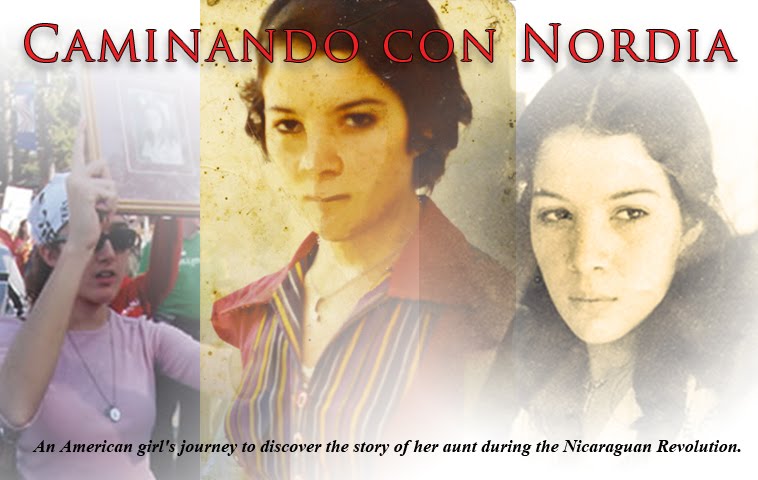
The purpose of this blog is to serve as a public accountability for a personal project. I seek to uncover and more deeply understand the struggle and sacrifice of my aunt, Nordia Esther González Hidalgo, during the Nicaraguan Revolution. I will be sharing my readings, research and reflections. This is my story of how I found hers.
Friday, August 16, 2013
Thursday, August 8, 2013
Almost-belated Birthday
So I have the practice of calling home to my parents to say good night every single night. Yes, every night. Rarely a day goes by without my evening check-in. Today my mother told me not to worry too much about missing these Nicaraguan fairs and festivals. It's just an excuse to make money. Companies exploiting cultural loneliness to make a profit, a ploy like Cinco de Mayo. She's only had negative experiences with Los Angeles Nicaraguan restaurants. They are not authentic or provide poor quality food. If I want a good Nica meal, I can just eat her food. I'm even learning to cook it on my own too. If I want to hear the music or witness the culture I can just watch the crazy antics of my uncles. She warned of romanticizing things the way people do with poverty. My mother did admit though, it would have been nice to hear Carlos Mejia Godoy perform while he's still around. Hopefully that opportunity will come again. I should not get distracted by the local street parties and try to focus on my aunt's story. I was caught off guard when my mom mentioned that today was Nordia's birthday. In fact, she would have turned 53 had she lived. Really? Today? How do I not know this? Why am I not keeping track? I'm devoting an entire blog to learning about her and I don't even observe her birthday! I was really disappointed in myself. I should have known. These three dates I must always strive to remember: June 13, the day she died, July 19, the day the war ended and August 8, her birthday. She died just before Somoza was overthrown and the revolution ended right before her birthday. Three months marked in memory. So now, at the 11th hour I take a moment to remember my aunt. I pause to acknowledge and give thanks for her tragically brief life, to recall what she did for her people, her country and the lasting impact she left on her family. Feliz cumple, Nordia. Hope you're enjoying some yummy birthday rosquillas in heaven. Rest in peace.
¡Qué Bárbaro!
So I apparently have again missed out on yet another Nicaraguan festival. What's especially cruel with this revelation is that it comes merely 4 days late. I was only 4 days shy of learning of this opportunity I could have attended. I've also been on high alert since discovering the other event from May. I am following and friending whoever necessary on Facebook and Twitter to track and monitor the Nicaraguan rumblings of Los Angeles. I do not know how these people advertise their fairs, but they somehow continually fail to reach out far and wide enough to catch me. It seems like I'm the one who's going to have to do the digging. Hopefully the future will be kinder to my curiosity and for once present with non-expired possibilities.
Wednesday, July 31, 2013
A falta de pan, buenas son semitas
The month of July passed me by in a whirl. Not much active progress on my part but a simple serendipitous encounter to serve as a reminder. While out on the road I briefly saw a sign that caught my eye. Though I passed by it quickly the words were unmistakable. It was a name. A name I thought a stranger to this city. After turning back around to slowly revisit it, my suspicions were confirmed. Carlos Mejía Godoy. Why was he being mentioned in Los Angeles? Who outside of Nicaragua even knows of the existence of this singer? Upon the second slower drive-by I could read a few more words...Nicaraguan festival. Who could be advertising a Nicaraguan festival here? This is California, not Florida. The majority of latinos here are of Mexican descent, not Central American. I was surprised and excited. Unfortunately, there was no time or space to actually pull over and give the sign a full read.
Thankfully, there's an internet out there that helps piece together some of life's more google-able mysteries. What I discovered was that this sign promoted a Southern Californian Nicaraguan festival, featuring both Carlos Mejía Godoy and Luis Enrique Mejía Godoy. The musical voice behind Nicaragua's uprising was going to be in my neighborhood, in the nearby City of Industry, to be exact.
Unfortunately the joy of this opportunity was quickly marred by sharp disappointment. The event had already occurred in May. The lonely street sign was merely a remnant of the past. The promise of upcoming adventure faded into nothing more than a ghost. How could this have gone unseen? How was I kept out of the loop? Where was their outreach? Why weren't the promoters recruiting every and all Nicaraguans of this city? How could I have never once heard of this festival?
My only lingering hope is that I can catch a future festival. Searching their website reveals that this was not a singular gathering. Previous events are scattered and don't show a clear pattern to monitor. I must remain alert for rumbles of the next opportunity. It is cruel to consider how far away this might be. There is no guarantee that Carlos Mejía Godoy will return either. I am forced to wait with anticipation.
Another random uncovering came again from the benefit of the world wide web, this time in the form of a book. I stumbled upon a guide to Nicaraguan Spanish, filled with the unique words and phrases that give this country its character. Since it boasted positive reviews from native Nicaraguans, I decided to lend it my trust and acquire a copy for myself. I have yet to share it with my family to get their perspective, but I can already see its potential to help me. There are several words in here that I have slowly struggled to understand along my way. This would have made things easier for me years ago!
One small, simple word that keeps popping up is "chapas" which are earrings. The first time I heard it was from my cousin's 3-year-old daughter last summer in Estelí. I was so confused what she was trying to say to me. I was dumbfounded. I felt stupid that my Spanish wasn't good enough to communicate with a child. I needed a translator. When I heard this word again in Susan Meiselas documentary, I jumped with excitement upon the recognition. It was a subtle affirmation of my experience and a confirmation of the validity of this word. Seeing it resurface in this book brings to light both memories. If only I had this guide sooner!
The book includes other words that my relatives struggled to explain to me without as colorful of a backdrop as the earring situation. Some words I eventually figured out on my own, while others took a bit of gesturing and explanation. There's even a small section devoted to the "vos" tense and conjugation, which I have only been able to pathetically mimic and not yet confidently master. Various sayings I never realized were Nicaraguan in nature are included as well. As I read them I can recall the voices of my family. The sights and sounds of my past come together to layer a framework and understanding.
Aside from highlighting my personal experience with the Nicaraguan colloquialism, this book offers me bearings to navigate through the phrases I'm encountering in my research. Words that confused me in the songs of Carlos Mejía Godoy now have context and meaning. This will be a helpful tool in reviewing his lyrics more deeply. Perhaps the next time he visits Los Angeles, this chavala will be better equipped to listen to his music and fully appreciate his songs. Maybe I wasn't meant to hear him until I beefed up my Spanish comprehension. Now that I have this tool, it is time to ponerme las pillas and get back to work. Even these little steps should help me in the grand scheme of things.
De grano en grano, se llena la gallina el gran buche.
Thankfully, there's an internet out there that helps piece together some of life's more google-able mysteries. What I discovered was that this sign promoted a Southern Californian Nicaraguan festival, featuring both Carlos Mejía Godoy and Luis Enrique Mejía Godoy. The musical voice behind Nicaragua's uprising was going to be in my neighborhood, in the nearby City of Industry, to be exact.
Unfortunately the joy of this opportunity was quickly marred by sharp disappointment. The event had already occurred in May. The lonely street sign was merely a remnant of the past. The promise of upcoming adventure faded into nothing more than a ghost. How could this have gone unseen? How was I kept out of the loop? Where was their outreach? Why weren't the promoters recruiting every and all Nicaraguans of this city? How could I have never once heard of this festival?
My only lingering hope is that I can catch a future festival. Searching their website reveals that this was not a singular gathering. Previous events are scattered and don't show a clear pattern to monitor. I must remain alert for rumbles of the next opportunity. It is cruel to consider how far away this might be. There is no guarantee that Carlos Mejía Godoy will return either. I am forced to wait with anticipation.
Another random uncovering came again from the benefit of the world wide web, this time in the form of a book. I stumbled upon a guide to Nicaraguan Spanish, filled with the unique words and phrases that give this country its character. Since it boasted positive reviews from native Nicaraguans, I decided to lend it my trust and acquire a copy for myself. I have yet to share it with my family to get their perspective, but I can already see its potential to help me. There are several words in here that I have slowly struggled to understand along my way. This would have made things easier for me years ago!
One small, simple word that keeps popping up is "chapas" which are earrings. The first time I heard it was from my cousin's 3-year-old daughter last summer in Estelí. I was so confused what she was trying to say to me. I was dumbfounded. I felt stupid that my Spanish wasn't good enough to communicate with a child. I needed a translator. When I heard this word again in Susan Meiselas documentary, I jumped with excitement upon the recognition. It was a subtle affirmation of my experience and a confirmation of the validity of this word. Seeing it resurface in this book brings to light both memories. If only I had this guide sooner!
The book includes other words that my relatives struggled to explain to me without as colorful of a backdrop as the earring situation. Some words I eventually figured out on my own, while others took a bit of gesturing and explanation. There's even a small section devoted to the "vos" tense and conjugation, which I have only been able to pathetically mimic and not yet confidently master. Various sayings I never realized were Nicaraguan in nature are included as well. As I read them I can recall the voices of my family. The sights and sounds of my past come together to layer a framework and understanding.
Aside from highlighting my personal experience with the Nicaraguan colloquialism, this book offers me bearings to navigate through the phrases I'm encountering in my research. Words that confused me in the songs of Carlos Mejía Godoy now have context and meaning. This will be a helpful tool in reviewing his lyrics more deeply. Perhaps the next time he visits Los Angeles, this chavala will be better equipped to listen to his music and fully appreciate his songs. Maybe I wasn't meant to hear him until I beefed up my Spanish comprehension. Now that I have this tool, it is time to ponerme las pillas and get back to work. Even these little steps should help me in the grand scheme of things.
De grano en grano, se llena la gallina el gran buche.
Friday, June 28, 2013
El Dios que Suda en la Calle
The resonate words of a song strike chords beyond the strings of an instrument and into the hearts of its listeners. With its texture and color, music can leave behind a powerful ring. The soundtrack to the Nicaraguan revolution would be the work of Carlos Mejía Godoy. His guitar provided the score for workers and revolutionaries and served to inspire and ignite the uprising. I am already familiar with some of his songs but I have been discovering even more of his music lately.
One of Godoy's projects was the "Misa Campesina" which is the Nicaraguan peasant mass. This was written on the island of Solentiname, known as an artistic community. When the Second Vatican Council allowed regional music at mass, Godoy was inspired to offer his own contribution to the liturgy. His mass parts were to debut in Ciudad Sandino at the Plaza de los Cabros during mass celebrated by Fr. Fernando Cardneal. However, the National Guard interrupted the service and broke up the mass, preventing the music from being shared. Fortunately, it spread on its own through secret, underground celebrations. The militia could not barricade the notes of hope reverberating among the choirs of people. Their cries for justice only crescendoed through the streets and augmented their ensemble.
I had only heard two songs total from this collection, each just a single track hidden within a different compilation. I decided to end my dissonance by searching for the lost tracks and the internet obliged. I was very grateful to find the complete set and fill in the missing puzzle pieces. What a powerful form of worship it is! If people only prayed today with this same authenticity, how deeper our faith would be. I imagine participating in a liturgy with this music must offer an intimate encounter with God.
The lyrics articulate how Christ is the God of the poor, one who is human and simple, sweating in the streets and holding us by the hand as we fight for justice in the city. God is real and present to our struggles. The songs take the mass and make it personal, a creed the people can identify with. In the melodious phrases the people offer themselves up in all their work to the Lord. They joyfully enter into communion in God's fields to taste His harvest of love, acknowledging that it is not some inconsequential ritual but a conscious commitment and experience that joins them all together. Even the farewell hymn lovingly reflects on the beauty of community united in their song and anticipating an encore.
I want to take the time to study these songs more closely and understand their dynamic range. Perhaps even learn the music and promote their use once again. I feel if I can enter into the song then I will better feel the beat within the heart of this symphony of struggle. I will be more equipped to compose my own requiem for my Tía Nordia.
I leave you with a playlist of nearly all the songs in the Misa Campesina Nicaragüense:
Thursday, May 30, 2013
Madre Nicaragüense
May 30th marks Mother's Day in Nicaragua and I wanted to take time to acknowledge these strong women who have endured so much. The Nicaraguan mother is built with a tough fiber. They are fierce protectors of their families and hard workers. I sometimes think they possess magic powers based on what I've witnessed from my mom. They use their gifts in service to their family and community. Whatever their story, they are all amazing women. Today I honor my mother, my grandmother, all my aunts and cousins, beautiful ladies of immeasurable strength and perseverance.
As I've been doing my research on the Nicaraguan revolution, I am continually reminded of my grandmother. I can't help but wonder about the burden upon her shoulders. The mother of twelve children, she worried for the safety of them all, whether they were fighting in uprising, looking for refuge in the mountains, or even far away in distant countries. It was a heavy weight to carry and a testament to her fortitude.
In the "Pictures from a Revolution" documentary, Susan Meiselas talks with some mothers. Many of these women lost at least one child during the war. One woman spoke angrily with regret. She felt her son died in vain. Another one spoke of the shock and disbelief. One woman explained how her work blossomed as a distraction to numb the pain. I found it interesting how for the sake of peace and healing, forgiveness found its form. They could understand that the mothers of the Contras were mothers like them, mothers who mourn the loss of their children. They could bond in their shared suffering. Through the capability of finding empathy across rival sides, the substance and character of these women shines boldly.
Mothers give us life and nurture life. In all their various efforts, their work is fruitful and life-giving. Sadly, on this Nicaraguan Mother's Day, my thoughts also fall onto the dark clouds of death. Four years ago today, my Tía Alba was buried after losing her fight to cancer. My cousin Yocasta observed Mother's day with a funeral. Both of my grandmothers have passed so I am reserved to hold on to their memory. As I recall my Abuelita Dora Hidalgo de Gonzalez, I think of the trials she faced having to let go of her children, especially the loss of my Tía Nordia.
The following song by Nicaraguan musician, Carlos Mejía Godoy, really struck me personally because it echoes the pain of my aunt and grandmother. It's asking where is the tomb of the guerilla-fighter? The mother is asking and no one responds. My aunt was killed and bull-dozed in a hill with over 30 other youths. Their parents had to dig through the dirt to recover limbs. Only the head and a leg were found from Nordia. My grandmother was in denial. She refused to accept that Nordia had been killed. She thought they couldn't properly identify the remains. Nordia was still coming. She was hiding, she was lost, she was far away, but she was still coming home. And she waited. I don't know how long it took her to accept that Nordia wouldn't come back, if she ever did. I don't know if she waited for her until her dying day. I do know that they are together again now. They have both come home.
I leave you with this song in honor of all mothers who have lost a child, especially the ones who dwell in the mystery of not knowing where their children lie. May they find strength and peace.
La Tumba del Guerrillero
by Carlos Mejía Godoy
La tumba del guerrillero
dónde, dónde, dónde está
su madre está preguntando
nadie le responderá
la tumba del guerrillero
dónde, dónde, dónde está
el pueblo está preguntando
algún día lo sabrá.
Guerrillero, vos surgis en ríos
montes y praderas
en el viento que mece el chinchorro
del hijo del Juan
en las manos humildes y toscas
de la vivandera
en la Milpa donde el campesino
busca y busca el pan.
Como dijo el poeta trapense
de Solentiname
no quisieron decirnos el sitio
donde te encontrás
y por eso tu tumba es todito
nuestro territorio
en cada palmo de mi Nicaragua
ahí vos estás.
Guerrillero, vos nacés de nuevo
en la carabina
en los bronquios de Pedro el minero
que en Siuna murió
en los ojos de los miserables que en Acahualinca
aún espera sedientos
la aurora de la rendición.
Como dijo el poeta trapense
de Solentiname
no quisieron decirnos el sitio
donde te encontrás
y por eso tu tumba es todito
nuestro territorio
en cada palmo de mi Nicaragua
ahí vos estás.
As I've been doing my research on the Nicaraguan revolution, I am continually reminded of my grandmother. I can't help but wonder about the burden upon her shoulders. The mother of twelve children, she worried for the safety of them all, whether they were fighting in uprising, looking for refuge in the mountains, or even far away in distant countries. It was a heavy weight to carry and a testament to her fortitude.
In the "Pictures from a Revolution" documentary, Susan Meiselas talks with some mothers. Many of these women lost at least one child during the war. One woman spoke angrily with regret. She felt her son died in vain. Another one spoke of the shock and disbelief. One woman explained how her work blossomed as a distraction to numb the pain. I found it interesting how for the sake of peace and healing, forgiveness found its form. They could understand that the mothers of the Contras were mothers like them, mothers who mourn the loss of their children. They could bond in their shared suffering. Through the capability of finding empathy across rival sides, the substance and character of these women shines boldly.
Mothers give us life and nurture life. In all their various efforts, their work is fruitful and life-giving. Sadly, on this Nicaraguan Mother's Day, my thoughts also fall onto the dark clouds of death. Four years ago today, my Tía Alba was buried after losing her fight to cancer. My cousin Yocasta observed Mother's day with a funeral. Both of my grandmothers have passed so I am reserved to hold on to their memory. As I recall my Abuelita Dora Hidalgo de Gonzalez, I think of the trials she faced having to let go of her children, especially the loss of my Tía Nordia.
The following song by Nicaraguan musician, Carlos Mejía Godoy, really struck me personally because it echoes the pain of my aunt and grandmother. It's asking where is the tomb of the guerilla-fighter? The mother is asking and no one responds. My aunt was killed and bull-dozed in a hill with over 30 other youths. Their parents had to dig through the dirt to recover limbs. Only the head and a leg were found from Nordia. My grandmother was in denial. She refused to accept that Nordia had been killed. She thought they couldn't properly identify the remains. Nordia was still coming. She was hiding, she was lost, she was far away, but she was still coming home. And she waited. I don't know how long it took her to accept that Nordia wouldn't come back, if she ever did. I don't know if she waited for her until her dying day. I do know that they are together again now. They have both come home.
I leave you with this song in honor of all mothers who have lost a child, especially the ones who dwell in the mystery of not knowing where their children lie. May they find strength and peace.
La Tumba del Guerrillero
by Carlos Mejía Godoy
La tumba del guerrillero
dónde, dónde, dónde está
su madre está preguntando
nadie le responderá
la tumba del guerrillero
dónde, dónde, dónde está
el pueblo está preguntando
algún día lo sabrá.
Guerrillero, vos surgis en ríos
montes y praderas
en el viento que mece el chinchorro
del hijo del Juan
en las manos humildes y toscas
de la vivandera
en la Milpa donde el campesino
busca y busca el pan.
Como dijo el poeta trapense
de Solentiname
no quisieron decirnos el sitio
donde te encontrás
y por eso tu tumba es todito
nuestro territorio
en cada palmo de mi Nicaragua
ahí vos estás.
Guerrillero, vos nacés de nuevo
en la carabina
en los bronquios de Pedro el minero
que en Siuna murió
en los ojos de los miserables que en Acahualinca
aún espera sedientos
la aurora de la rendición.
Como dijo el poeta trapense
de Solentiname
no quisieron decirnos el sitio
donde te encontrás
y por eso tu tumba es todito
nuestro territorio
en cada palmo de mi Nicaragua
ahí vos estás.
Monday, May 20, 2013
Woman on a Mission
When I was a student at LMU I learned about the film, The Mission, directed by Roland Joffe. Recently, I heard the music of "Gabriel's Oboe" and it reminded me of the movie. I found it online, ordered it and watched it again. There is a special feature documentary about working with the indigenous people during filming. At one point they talk to a local Jesuit who was facing his own modern day challenges. He referenced being in Central America and in particular Nicaragua. I sat upright at the sound of the name. I knew this movie was similar in nature to the story I am searching for but I didn't expect such a direct link. It was an in-your-face reminder of what my mission is. I'm glad I'm finding these little things around me to keep me on course. It is definitely an affirmation and I embrace it.
Subscribe to:
Posts (Atom)


