Welcome

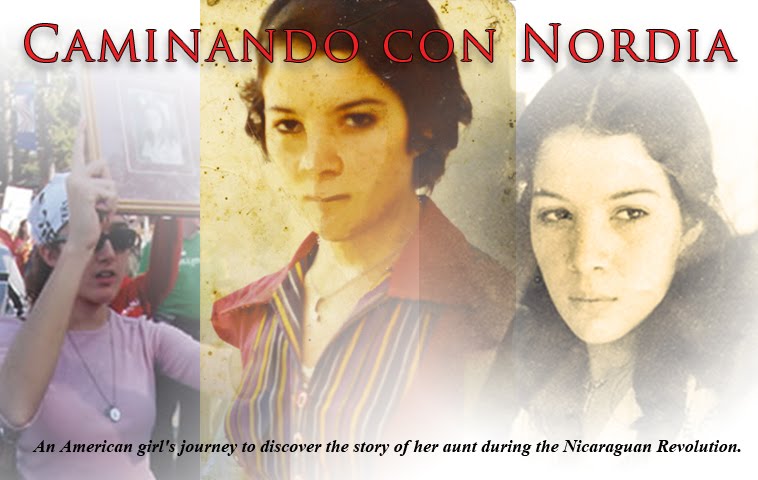
The purpose of this blog is to serve as a public accountability for a personal project. I seek to uncover and more deeply understand the struggle and sacrifice of my aunt, Nordia Esther González Hidalgo, during the Nicaraguan Revolution. I will be sharing my readings, research and reflections. This is my story of how I found hers.

Friday, May 17, 2013

Contra-flicted

I've been conflicted about a few things as I make this journey to learn more about my aunt.  A simpler problem has been just figuring out what is the narrative focus of this blog.  Is it more to track my experience doing research or is it to actually share the content of what I'm learning?  The goal was basically to keep me accountable to this project but the direction to take it was undefined.  A few months ago I wrote about watching the documentary, "Pictures from a Revolution," by Susan Meiselas and the excitement that erupted from finally breaking in my notebook.  It was well-received but my mother asked about the actual video.  She wanted to read about what I was actually discovering.  So in the following entry I decided to break down and review my notes.  It was a bit more challenging than expected.  Some things I jotted down were emotional responses, memories of my personal visits to Nicaragua, words and phrases that caught my attention and striking imagery.  I'm not just seeking facts and details for an informational report, but considering all the elements that would provide more character and nuance if I were to attempt to write a novel or even a screenplay.  Deciphering which scribbles are worthy of blogging is part of the mystery of this game.  Actually writing the new entry was a bit of a chore as well because it almost felt too scholarly.  I didn't feel like writing a book report.  I was out of practice from reviewing notes, analyzing them and writing up an insightful discourse.  My school days are far behind me and I didn't want to taint this blog with the blandness of academic essays.  However, this overall problem does not deeply concern me and I am confident that with time I will find my proper voice.

An another issue that has popped up and seems to haunt me revolves around the Contras.  To grossly over-simplify things, you can look at the Nicaragua revolution in two parts: first with the uprising and over-throwing of the Dictator Somoza and secondly with the counter-revolt fighting for control over the newly freed country.  The first half seems pretty straightforward: get rid of the bad guy oppressing the people.  The second half is incredibly more complicated and laced with political tension.  I just wanted to avoid the second war altogether.  Nordia's story doesn't lead to that time.  Nordia died before the first revolution had ended.  Unfortunately, I am learning time and time again that I can't view history in a narrow lens to suit my fancy.  I can't pick and choose what parts are more "interesting or entertaining" if we are even allowed to describe these difficult times with such terms.

Since Meiselas's documentary returns her to Nicaragua ten years after the initial uprising, she is able to get some of that disenchanted counter-perspective.  According to one woman,
"Many  mothers of those who died regret the deaths of their children.  They fought so much -to die- and for nothing.  For a Nicaragua without a real triumph, a Nicaragua exhausted-that's what we have now."
Is that how my grandmother felt about the loss of her youngest daughter?  I know she denied the Sandinistas a photo of Nordia to use for the memorial of those who died on Hill 110.  Did she resent what the war did to her family?  Susan goes on to note the growing distance between those running things and those who fought.  One person, however, was torn and disturbed about the current disappointment.  He felt that the price of revolution, the blood, suffering and pain, was to great to betray it.  He explained,"The revolution did not fail us.  The revolution didn't fulfill all of its promises." He said the revolution was clipped of its wings and not able to grow.  Susan spoke with various people who were upset with their current situation.  Some felt they were naively hopeful for better while others knew the poverty would remain constant but thought the freedom was enough of a difference to matter.  It was really interesting to hear the different view points.

What I was most surprised to witness was the authentic emotion from former national guard members.  To me, they were the enemy, pure evil.  But as Susan interviews them they become human again.  I was shocked that I could even be capable of sympathizing with someone from the guardia.  A saw a man in tears about losing the war, honestly believing he was fighting on the right side.  He broke down expressing,
"We were used just as the Sandinistas were used.  We were caught in a war game between the powers. The Russians supplied the Sandinistas.  The United States supported us.  And they started to play with us in a way which was, after a point, dishonest...you become nothing more than a puppet."

A puppet.  A puppet in a very sad play where outside nations pulled the strings.  The Nicaragua people fought for themselves, not any political ideology.  Unfortunately there were too many powers invested with the outcome of this country.  Everyone wanted to claim Nicaragua as their own pawn on the global chessboard.

And so I must accept that the story of the past is not so black-and-white but thick with gray.  I have to be careful how I present some things because of how it will unfold later.  I remember one of my uncles mentioned that something I wrote before felt wrong or ignorant.  It was too ideal whereas he knew the dark reality.  Another time a different uncle said something about my sister being innocent with optimism.  It was almost as if we were falling into the trap of romanticizing history and heroizing the flawed.  I know they might be burdened by the haunting past of their experience which influences their perception, yet it was worth taking note.  Watching the documentary reaffirming this lasting bitterness.  They even went as far to mention that this wasn't a war like "the American movies where the hero walks in."  There aren't clear good guys and bad guys and history should not be depicted as a feel-good action flick.

Normally we are told we must understand the past to better approach the future.  In the case of studying the Sandinista uprising and uncovering Nordia's story, I'm going to have to come to grips with the future to authentically portray the past.

Tuesday, April 30, 2013

Viene

They were coming.

What exactly, no one knew for sure.  Anticipation soaked the air.  In her documentary, "Pictures from a Revolution," Susan Meiselas notes how the response to the casual greeting, "¿Que pasa?" was a foreboding "viene."  It comes.  The revolution was stirring among the hearts of the Nicaraguan people, yet not fully formed.  It was unclear what shape it would take.  Even with the uncertainty, there was no denying that something in fact was trembling within the earth, ready to burst free.

In the sing-song accent that graces the tongues of central-americans, a woman sells tomatoes on the streets.  Amidst the transaction of goods, details for a secret meeting are also exchanged.  The movement may have been gentle and quiet, but the pot was still stirring.

Meiselas journey in Nicaragua unveils the complexities of the build-up and climax of the Sandinista uprising, as well as the bitter aftermath.  I really appreciated the rich variety of opinions she was able to record.  Being present during both the revolution and again ten years later allowed her to offer a unique perspective.  I want to take the time to reflect on these different dynamics that all come to play.

Susan was just a photojournalist who felt obligated to capture what unrolled before her eyes.  She explained, "History was being made in the streets and no one knew where it would lead."  At one point while she was amid the crowds of people taking pictures in the streets, someone grabbed a bullet shell from the ground that the National Guard had fired and shoved it in her face so the inscription was clear for her to read.  This device of death revealed the true architect of their misery: Made in the USA.

There were powers backstage manipulating scene, pulling the strings on their puppets of poverty.  Capitalism and communism took a stake in the outcome of the turmoil in this developing country.  I was hoping I could focus on learning about the first uprising without having to delve too much into the counter-revolution.  My aunt's story ends before the Contras were formed.  Unfortunately the history of this battle for justice is tainted with politics.  Both phases of history are intertwined and I can't ignore one if I want to understand it all fully.  For the Nicaraguan people however, it was never about the larger schisms of the globe.  They fought for their own country and their dignity.

One man explained:
"I became aware of the reality for us, the poor, under a government that defends capital interests.  That's what gives birth to this conscience to fight for the poor.  We are poor and we fight for the others who are still undecided.  This is what moved me personally to take that step, to join the struggle."

Slowly but surely I join the struggle.  Though the progress is mild these gentle rumblings give rise to more.  It is coming.

Viene.

Friday, March 22, 2013

Pen to Paper

I finally put pen to paper.  It was a glorious physical embrace.  The blue ink danced upon the fibers as I conducted their music.  A long time ago I bought a large 3-ring binder and a college-ruled notebook for me to use while researching Nordia's story.  Since then I managed to place a lovely print-out of her face in the clear-view front outside pocket.  The insides remained untouched except for the photocopy of the Nicaraguan book about Colina 110 I had managed to acquire from the Library of Congress.  It served more as a decoration than anything else.  A reminder of a dream.  A promise to protect.  Void of any real activity until last night when I woke them from their slumber.

I had finally decided to take some notes.  And I filled 7 pages with content.  I had wanted to do this physically and not digitally as to better absorb the information into my memory.  The subject was, "Pictures from a Revolution," a 1991 film following journalist Susan Meiselas as she seeks to track people she photographed ten years earlier during the uprising.  I had already watched this dvd once before.  I decided early on to just sit through and watch it without being preoccupied with jotting down the details.  I remember it really struck me back to hear the personal stories of so many different people. There was much emotion behind every perspective.  I honestly don't remember when I watched it, but I quickly realized it must have been before my summer trip to Nicaragua.  I was reacting to things now that I didn't notice before.  The sights, the sounds, the accent and the slag were all more familiar to me now.  I had a new appreciation for what I was witnessing with my trip in recent memory.  Even though August seems long ago at this point, it's impressive to witness what can be recalled by the simplest triggers.

I originally turned to this dvd after a frustrating failed attempt to begin reading the Spanish-language book.  I hadn't realized how weak and out of practice my Spanish reading comprehension was and decided I needed to warm up with something simple.  A dvd with English subtitles was perfect.  I watched it but didn't take notes.  I knew I had to revisit it but was for whatever reason was delayed.  The film is from the perspective of a photographer trying to document history in the making.  After I had gone to Nicaragua and discovered the beautiful picture of my mother, grandmother and aunts I was reminded of the power of a picture once again.  I knew that would be my first step.

More time passed again in my usual pathetic ineffective way until in March I traveled to Milwaukee, Wisconsin to visit my little sister for her 25th birthday.  We decided to visit the art museum by the lake. They had a special exhibit celebrating 75 years of color photography.  As we were walking along the corridors I noticed hidden away in the corner two very familiar pictures.  My body had recognized them and pulled me over before my brain could process what I was seeing.  I called out to Jessica as she was already moving in the other direction.  On display were two photographs from Susan Meiselas taken during the Nicaraguan revolution.  What was Nicaragua doing in Wisconsin?  In a museum filled with mostly white patrons, we two sisters found ourselves staring into a glimpse of our mother's history.  It was the craziest affirmation of sorts.

So then, exactly two weeks later, I am revisiting those exact same photographs in the dvd once again.  Now I acknowledge them with authority.  I appreciate them on a new level.  Taking notes was a bit odd because I was pulled in so many directions.  Part of me was trying to capture the facts, or observe the sights and people while another side was more in a journal-mode wanting to claim the emotional journey.  I wasn't exactly sure what belonged in the note-book.  I had to pause the dvd a lot so I write down some important quotations.  The very words of the Nicaraguan people resonated deeply.  There was much richness to behold.

A first step, a baby step, but a step none-the-less.  And a step in the right direction.  I look forward to making more contact with pen, paper and anything along the path that this road has to offer me.

Thursday, February 28, 2013

Struggling

I'm obviously  struggling to keep up with this personal project of mine.  It's quite frustrating that it just doesn't naturally fall into place.  I promised myself I would at least post one entry in a month at the very minimum.  Now I find myself on the last day of February without any progress.  It saddens me to see how little I've done.  What is the challenge?  I just don't have the time, energy or focus?  There are definite upswings in momentum but I need to harness that and maintain the flow.  I'm tired of all these blog entries being about what I hope to do and nothing actually following through with any of it.  I have acquired some DVDs and even an old VHS tape that I will eventually watch and take notes.  When this will honestly happen, who knows?  I have plenty of books I could be reading too.  To be fair, it was a brutal month at work and it still continues to drain me.  Behind a desk all day burns me out by the time I get home and usually don't want anything to do with a computer.  I take the evening to rest. I guess all journey's have their ups and downs. I hope this is merely a hurdle along the path.  I know I am truly interested in gaining a deeper understanding of my aunt's participation in the Nicaraguan revolution.  I do like to imagine how I will retell and share her story with the world.  I just hope I can get out of the dream and enter reality. It is time to wake up. The resting must end.

Friday, January 18, 2013

Resolved

For creating this blog to keep me accountable on my family research, I haven't been very productive on it.  Life's distractions seem to keep getting in the way.  I've been on a quite a roll for the past several years with my annual new years resolutions and need a different focus for 2013 so I feel this will be the perfect time to truly embrace this project.  I am determined to take this to the next level and not let it just be a passing curiosity.  Ironically, I keep imagining blog entries but don't really get around to it.  I think of the title and know the content before I actually write anything.  So far I have managed to watch a very informative DVD but I wanted to give it a second viewing before really taking notes.  I traveled to Nicaragua and visited the land where my aunt fell in battle but spent more time in fellowship with my family than in investigation.  Over the summer I had a serious discussion with my mother and uncle about the Sandinista uprising, the Contra revolution, different associations and stigmas.  Recently, my mother was able to better remember the mystery behind all the smiles in the charming photo I discovered while in Nicaragua.  My knowledge is definitely growing, even if my written, organized notes and blog entries aren't.  Being 8 years after my college graduation also makes the academic discipline a little foreign and awkward.  I think I need to slowly warm up to this.  I want to watch all the movies I can find first, then tackle the English-language books and materials and then move up toward Spanish literature.  I will commit to at least one blog post a month but will try to build toward bi-weekly and then weekly entries.  I just need to get the ball rolling and then hopefully the rest will follow.

I am resolved to making 2013 the year of Nordia.

Friday, December 28, 2012

Seasonal Songs of Solidarity

When my mother left for the United States, her sister Nordia let her take their songbook with her so she could remember their time together at the local church choir.  It was a collection of church hymns, folk songs, liberation music and Christmas carols.  They were involved with various ministries and really enjoyed singing these songs.  There was a lot of substance within the lyrics.  To this day my mother has saved the little songbook.  It is a little treasured relic.  In light of the holiday season, I wanted to share this Nicaraguan Christmas carol that is so much more profound than any Santa Claus jingle we offer in the United States.  Below are the original Spanish lyrics followed by the translation.


My mother and aunt's original songbook


Navidad en Libertad
Carlos Mejía Godoy

Cuando desempaques tus regalos
niño de lujosa vecindad
piensa en tantos niños que no saben
para qué es la navidad
piensa en el chavalo limpiabotas
que su nochebuena pasará
en una banqueta dura y fría
del atrio de Catedral

Feliz Navidad
feliz Navidad
en Justicia y Libertad
feliz Navidad
un mundo mejor
sin miseria ni opresion

Esa metralleta de juguete
que te trajo este año Santa Claus
es el aguinaldo cariñoso
que te manda el Tío Sam

Hoy necesitamos más escuelas
mas cultura y más educación
son más importantes cien maestros
que un blindado batallón

Feliz Navidad...

Tiene que venir pronto ese día
cuando no sea la Navidad
sólo el privilegio de los ricos
sino de la Humanidad

Que venga Venancio, Pedro y Mincho
la Maruca, Lencho y Pantaleón
vamos a cantar el Villancico
de nuestra Liberación.

Feliz Navidad....

Hablado: Feliz Libertad te deseo, Pueblo mío.  Feliz Libertad niño de Acahualinca y Miralagos.  Feliz Libertad niño mutilado del Vietnam.  Feliz libertad niño huérfano de Nagasaki.  Feliz Libertad, negrito murruco del Congo.  A todos los niños del Tercer Mundo…Feliz Libertad.

Translation:

Christmas in Liberty

When unpacking your gifts
luxurious neighborhood boy
think of the many children who do not know
what is Christmas for.
Think of the shoeshine boy
That will spend Christmas Eve
On the cold hard sidewalk of the
Cathedral atrium

Merry Christmas
Merry Christmas
in Justice and Freedom
Merry Christmas
a better world
without misery nor oppression

That machine gun toy
that Santa Claus brought you this year 
is the affectionate bonus
sent from Uncle Sam

Today we need more schools
more culture and more education
One hundred teachers are more important
that an armored battalion

Merry Christmas ...

Soon the day must come
When Christmas is not
only the privilege of the rich
but of Humanity

Come Venancio, Peter and Mincho,
Maruca, Lencho and Pantaleon,
We will sing the carol
of our Liberation.

Merry Christmas ....

Spoken: I wish you, Happy Freedom, my people. Happy Freedom, child of Acahualinca and Miralagos. Happy Freedom, maimed child of Vietnam. Happy freedom, orphan of Nagasaki. Happy Freedom, dark curly-haired child of the Congo. To all the children in the Third World ...Happy Freedom.


Friday, November 16, 2012

The Weight of a Date


November 16 holds a lot of weight for me in many different ways.  So many different events have fallen on this day that it's sometimes overwhelming to remember them all.

My first memory of a significant November 16 was in 2001 when I was a college freshmen.  This was the birthday of my roommate, Valerie Jacobs, so the whole west wing of the Sullivan dorm at LMU was going out to celebrate.  She was a Potterhead and the very first movie was about to be released.  I didn't have any classes on Fridays so I spent the day reading Harry Potter and the Sorceror's Stone to get ready for our evening at the theater.  I fell in love with the book and movie and anyone who knows me knows what a hard-core fan I became.  I trace the obsession back to this date.

Aside from launching my fandom of The-Boy-Who-Lived, this day is marked for me on a much more serious and somber level. It's actually much more about those who died.  On November 16, 1989 six Jesuit priests, their housekeeper and her daughter were massacred at the Universidad Centroamericana (UCA) in El Salvador.  Being a public school kid, I had never heard about this until attending LMU.  Jesuit schools and universities always host memorials in honor of these victims.  I was particularly interested because it involved Salvadorans.  For one thing, Central America always feels like the forgotten area of Latin America and as someone of Nicaraguan decent, I always appreciated any attention to this region.  Secondly, our long time family friends and neighbors were Salvadoran so there was an instant connection and interest.  It turned out that the Annicchiarico family actually knew personally these Jesuit priests before they were killed.  Several of them also happened to be Spaniards, so I could even relate from my father's side of the family as well.  All in all, I was invested in learning more and understanding things better.

The victims were murdered by soldiers who were trained by the United States.  They were trained at Fort Benning, Georgia, at what was then called the "School of the Americas" or SOA.  Every year in November there is a protest and procession to remember the lives of everyone murdered by the students from that training program.  I signed up with Campus Ministry to attend during my junior year of college.  They take the time to prepare us intellectually and spiritually for this journey.  It was during the course of this preparation that I realized the SOA was associated with the National Guard in Nicaragua.  This started my initial questioning of the story of my aunt.  Learning about the deaths of these Jesuits brought light to the life of my aunt.  I had never really questioned who killed her or why she died.  I just took it as a casualty of war.  Suddenly, this whole trip became more meaningful personally to me than it already was.  As part of the procession participants carry white crosses to represent the victims killed by the SOA.  Some have names, some don't.  We leave the crosses at the gates.  I brought with me a picture of my aunt.  I knew the students there contributed to her death and I wanted her name and face included in their list of crimes.

Learning about the deaths at UCA led me to somewhat better understand the death of my aunt and I will always associate them together and appreciate that.  It helped me begin this journey.

Lastly, on November 16, 2006, while I was full blown in the middle of the chaos of production on The Simpsons Movie, my Nicaraguan grandmother, Dora Hildalgo de Gonzalez, passed away from her battle with cancer.  I hadn't seen her in years.  My mother left for Esteli to be with her for her final months.  My grandfather had passed when I was too young to remember so she was my first real experience losing a close family member.  It was really hard for me to acknowledge that I would never get to say good-bye and couldn't attend her funeral.  It's one of the many challenges facing first-generation Americans with such distant family.  I barely visited her tomb for the first time this past summer in August of 2012, 6 years later.

So today, November 16, I take time to remember the life of my grandmother,  the victims of the massacre at UCA and all the lives lost at the hands of SOA graduates and in turn my Tía Nordia.  It is fitting that November starts with All Saints Day and All Souls Day.  This month is saturated by the memory of those gone before us.  I must do my best to take the time to honor their lives.

Dales Señor, el eterno descanso y que brille para ellos la luz perpetua.
Descansen en paz.
Así sea.